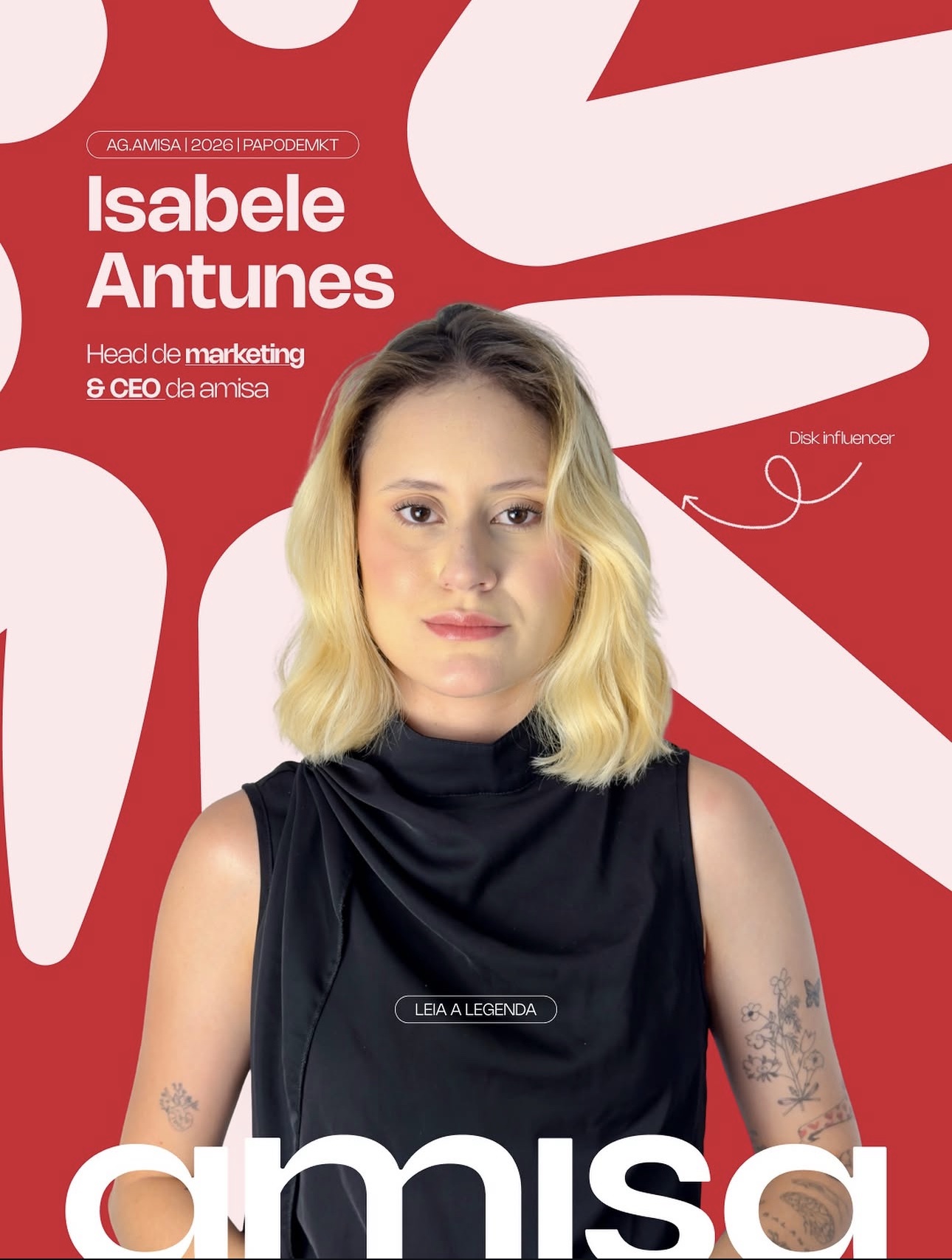
Isabele Antunes is 24 and has already tried more careers than most people try jobs: she worked as a model, in mechatronics and aircraft maintenance, lived in Amsterdam — until she planted her flag in marketing, a field she's worked in for six years and now leads at Amisa, a full-service agency focused on branding and strategy. In our conversation, she raised a warning most Brazilian marketing teams haven't taken seriously yet: Google stopped being the sole judge of who shows up online — and who disappears.
If I search "tech entrepreneurs" in an AI, your name has to show up. If it doesn't, you're missing a GEO strategy behind it.
— Isabele Antunes
What GEO and AIO Are — and Why SEO Alone Isn't Enough Anymore
For nearly two decades, the metric that decided whether a business existed online was Google's first page — classic SEO: optimizing a site for a search engine's indexing criteria. The rise of LLMs — the language models behind ChatGPT, Gemini, and Claude — opened a second front, which Isabele sums up in two acronyms: GEO (Generative Engine Optimization) and AIO (AI Optimization). The question is no longer just "am I on page one?" — it's "does the AI recommend me when someone asks about my market?"
GEO and AIO adapt SEO logic to the world of generative AI models: instead of optimizing for a list of links, the strategy optimizes to be cited inside a chatbot's answer. The storefront is no longer the search result — it's the sentence the AI decides to give you.
How to Start Showing Up in AI Answers
GEO is still a new field, but a few practices already work — and any company can start applying them without rebuilding its site from scratch:
- Structured, direct content — clear answers to specific questions in your industry are more likely to get cited by an LLM than generic sales copy.
- Authority outside your own site — press coverage, portals, and external mentions still matter: the same link-building logic from classic SEO, now training the AI to recognize who's a reference point.
- Consistent information — name, specialty, and positioning need to match everywhere the brand appears online. Generative AI cross-references sources; inconsistent information lowers the odds of being cited.
- Active presence, not a static one — updated profiles and content carry more weight than an institutional page untouched since 2022.
The Real Fear of People Who Live Off Marketing
Isabele didn't hide her discomfort: she resisted generative AI at first and remains skeptical about the industry's direction. The risk she sees isn't the technology — it's marketing outsourcing creativity to a ready-made AI report and shipping it without review, without the "human touch" that, in her view, is what actually makes a strategy work.
I still don't agree that AI is going to do my job. It can help me, but I'm going to review what it produces, I'm going to add my human touch.
— Isabele Antunes

Amisa: Full-Service Marketing, From Branding to GEO
Amisa covers marketing end to end — from a profile starting at zero to companies that already have an in-house team and want specialized reinforcement in SEO, GEO, and AIO:
- 360 strategy and consulting — a full diagnostic of a profile's current state before any execution begins.
- Social media and branding — including full rebranding when a company needs to change direction.
- SEO, GEO, and AIO — optimized presence across traditional search engines and generative AI answers.
- Public relations (PR) — coordination with press outlets, including articles that reinforce a company's SEO.
The Numbers Behind the Career
The most revealing part of the conversation wasn't conceptual — it was the results. Four milestones sum up what "marketing that works" means in practice:
- From 8,000 to 14,000 followers in 1 year — organic growth built from a real sense of community, not just posting content.
- R$2 million ($400k+) generated in 1 day — from a campaign that was mostly offline, proof that digital marketing alone doesn't solve everything.
- From 55-57% to 69.5% qualified leads in 1 month — in a campaign where volume also grew, reversing the industry's usual pattern: more volume normally means lower quality.
- International experience in Amsterdam — where she learned to design organic strategies for markets that don't revolve around social media, unlike Brazil.
The Most Common Mistake Companies Make Today
Asked about the main mistake she sees in companies, Isabele didn't hesitate: rushing. Marketing has always had an "everything was due yesterday" culture, and AI became the perfect shortcut to feed that urgency — at the cost of delivering the exact same generic report anyone, in any field, could get from a chatbot.
You can go to an AI, ask it to build a strategy, and it will deliver one. It's not your job, but you're handing over the same thing a marketing professional would.
— Isabele Antunes
Advice for Anyone Starting Out in Marketing
Isabele's advice for people entering the field now isn't about any tool — it's about posture. Stay open to learning from anyone who knows even 1% more than you, and resist the urge to specialize too early in a single lane, like social media. In her words, marketing is "very vast" and rewards whoever becomes versatile enough to work across all of it.
The conversation converges on one point: technology — a search algorithm or an LLM — changes the storefront, but doesn't replace the judgment of whoever understands the business behind it. GEO and AIO are the new structure. Human judgment is still what makes that structure work.
Never think an idea is silly or won't work. Listen to what comes from inside you, and don't be afraid to put it out there — that's how marketing flows.
— Isabele Antunes